From Brain Test to 1.6 Billion Downloads: Inside Unico Studio with Erkay Uzun
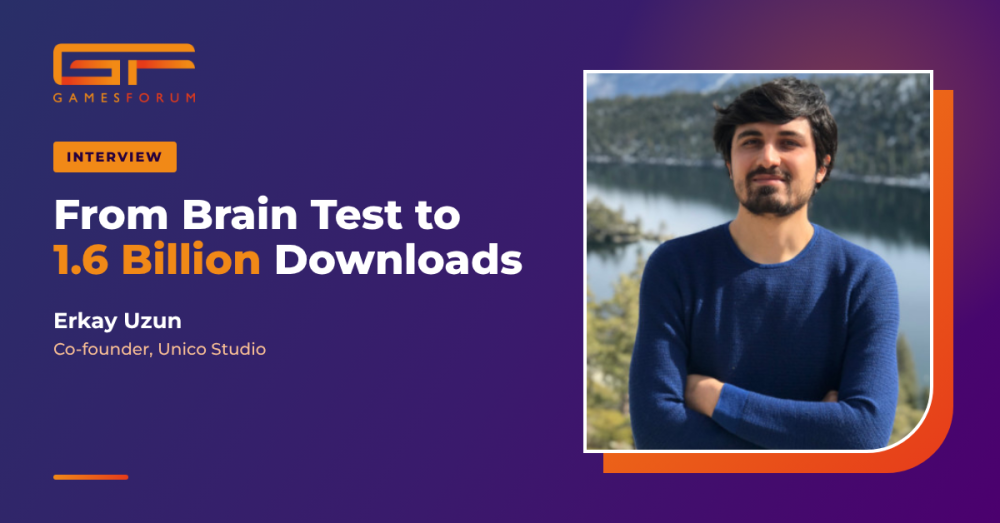
From a bootstrapped start in 2018 to more than 1.6 billion downloads, Unico Studio has become one of mobile’s most recognisable names in hybrid-casual. Best known for the chart-topping Brain Test franchise, the Palo Alto-based studio now runs a portfolio of 100+ games and a growing publishing arm backing independent developers.
We caught up with co-founder Erkay Uzun to talk about the company’s early days, what Brain Test’s breakout success taught the team about scaling, why they moved into publishing, and how he sees AI reshaping the way games are made and grown.
Q: For those who may not know, tell us about Unico and what you do.
Unico Studio is a mobile game developer and publisher that I co-founded in 2018. We're headquartered in Palo Alto. Today, we have over 130 team members, more than 100 games in our portfolio, and over 1.6 billion downloads worldwide.
We're best known for our Brain Test franchise and our strong presence in hybrid-casual game publishing. Our focus has always been on creating accessible, entertaining games that can reach players across different ages and cultures.
My role has evolved over the years, from being deeply involved in product development and growth to focusing more on strategy, partnerships, and exploring new opportunities for the business.
Q: Take us back to the beginning: how did you and your co-founder come together, and what were you trying to build?
My co-founder is actually my wife, Elif, so we were partners long before we became business partners!
I come from a computer science and engineering background and had already been building mobile games for several years. Elif brought a strong creative and design perspective. We felt that combining those strengths could help us build something special.
We started Unico in 2018 with a small team and a simple ambition: create games that millions of people around the world could enjoy. We were bootstrapped from the beginning, so we had to be creative, move quickly, and learn from everything we tried.
There's also a personal story behind the name. Our daughter loved unicorns, and that's where "Unico" came from. I think that playful spirit has stayed with us ever since.
Q: Along the way, your games have reached millions of players. Was there a breakout moment, and how did it change the way you worked?
Definitely Brain Test. We launched it in 2019, and it quickly became a global hit, eventually reaching #1 on the US charts.
What made Brain Test special was its simplicity. We wanted to create puzzles that would surprise people, make them think differently, and sometimes make them laugh. It turned out that this kind of experience could connect with players almost anywhere in the world.
The game grew much faster than we initially expected. Suddenly, we were managing millions of players with a relatively small team.
That experience completely changed how we operated. We invested heavily in analytics, user acquisition, creative testing, monetization, and live operations. More importantly, we learned that launching a successful game is just the beginning. Building something that players continue to enjoy for years is the real challenge.
Q: You now also work with other developers through your publishing arm. What made you move from making your own games to backing other people's?
After scaling our own games to hundreds of millions of downloads, we realized we had built a lot of valuable expertise beyond game development itself.
We had strong capabilities in user acquisition, monetization, analytics, creative production, and scaling games globally. At the same time, we were meeting talented independent developers with great ideas who didn't necessarily have the resources or experience to take their games to a global audience.
Publishing felt like a natural next step.
Our philosophy is that a publisher should do much more than provide funding and buy users. We work closely with developers on game design, retention, in-game economies, and long-term growth, while respecting their creative vision.
For us, it's exciting to help a small team with a promising idea turn it into a successful, sustainable game business.
Q: Looking ahead, what's the next chapter for Unico, and what will change most about how games are made and grown?
For Unico, the next chapter is about building stronger, longer-lasting game franchises and expanding our publishing partnerships, particularly in the hybrid-casual space.
But looking at the industry more broadly, I believe AI will fundamentally change how games are developed and marketed.
We're moving toward a world where small teams can prototype ideas, create content, produce marketing creatives, and test different concepts dramatically faster than before. I think AI-powered creative production and playable ads, in particular, will transform how mobile games acquire players and grow.
This will lower the barriers to creating games, but it will also make the market even more competitive.
Ultimately, I believe creativity, understanding player psychology, and knowing what makes a game genuinely fun will become more important, not less. AI will make execution easier, but great ideas and great judgment will still be what separates the winners.


Home of the Gamesforum events series and leading mobile game analysis. Discover everything you need to know about mobile games marketing and monetization.